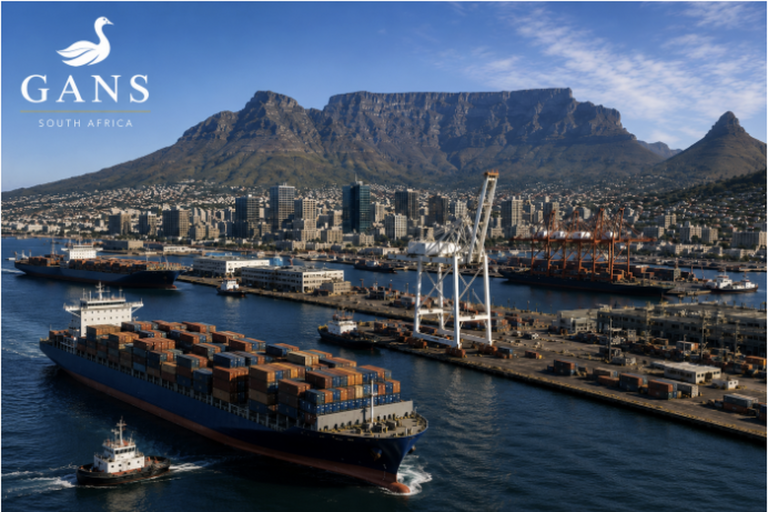
- GANS Trade Insight
International freight connects South African exporters with customers across the world, but every transport movement also produces greenhouse-gas emissions. As buyers set supply-chain targets and request more detailed environmental information, exporters are increasingly expected to understand the emissions associated with delivering their products.
Reducing freight emissions does not require a single dramatic change. The most practical opportunities often come from better measurement, fuller loads, improved routing, appropriate transport modes and fewer urgent shipments.
These changes can also produce commercial benefits. More efficient freight planning may reduce handling, packaging, storage and transport costs while improving delivery reliability.
Understand where freight emissions arise
Freight emissions are affected by more than the distance between the exporter and customer. The complete transport chain can include:
- Collection from the supplier
- Transport to a warehouse or consolidation point
- Inland movement to a port or airport
- Terminal handling
- International sea or air freight
- Transhipment between vessels
- Customs storage
- Delivery from the destination port
- Refrigerated transport and warehousing
- Empty vehicle or container movements
A shipment travelling through several indirect stages may generate more emissions than the exporter expects from the main international leg alone.
The International Maritime Organization estimated that total shipping emitted 1,056 million tonnes of CO₂ in 2018, representing approximately 2.89% of global anthropogenic CO₂ emissions for that year. Under the study’s voyage-based allocation, international shipping accounted for 740 million tonnes. IMO Fourth Greenhouse Gas Study highlights
These figures demonstrate the scale of the sector, but an individual exporter should focus on the routes, carriers and shipment decisions it can influence.
A business cannot manage freight emissions effectively without understanding its starting point. The initial baseline should cover a consistent reporting period and clearly define which transport activities are included. Useful shipment data includes:
Product, weight, volume, packaging dimensions and temperature requirements.
Origin, destination, distance, mode, vehicle or vessel type and intermediate handling points.
Supplier information
Carrier, freight forwarder, fuel information and whether the calculation uses actual or estimated data.
The GHG Protocol addresses purchased inbound freight under Scope 3 Category 4, upstream transportation and distribution. It addresses relevant downstream transportation and distribution under Category 9, depending on who purchases and controls the service. GHG Protocol Scope 3 calculation guidance
Businesses should define the boundary before comparing results. Changing which transport legs are included can create an apparent improvement or increase even when physical operations remain unchanged.
Furthermore, the merger provided Company with enhanced buying power through the combined volume benefits from shared suppliers. This advantage led to a reduction in the cost of goods sold (COGS), further contributing to overall cost savings.
Through our diligent efforts, we identified hundreds of millions of dollars in cumulative synergies that Company could capitalize on following the merger. The company has successfully reinvested a significant portion of these savings into strengthening its brands and fostering continued growth and success.
Use a consistent calculation method
Freight emissions are commonly calculated using activity data multiplied by an appropriate emissions factor.
A simplified calculation may use:
Cargo weight × distance travelled × mode-specific emissions factor
More detailed methods can incorporate fuel use, equipment type, load factor, empty running, refrigeration and logistics facilities.
The Global Logistics Emissions Council Framework provides a recognised methodology for calculating logistics emissions across transport modes and sites. It also formed the basis for ISO 14083, the international standard for quantifying and reporting greenhouse-gas emissions from transport-chain operations. Smart Freight Centre GLEC Framework
Exporters do not always need to perform every calculation internally. Freight providers may supply shipment-emissions reports, but the exporter should understand the methodology and whether figures are based on actual carrier data or industry averages.
Select the appropriate transport mode
Transport mode is one of the most influential freight-planning decisions. Air freight provides speed but generally has a significantly higher emissions intensity than ocean freight. Sea freight may be more efficient for planned larger volumes but requires longer lead times.
The lowest-emission mode is not always operationally suitable. Perishable goods, emergency components and time-sensitive customer requirements may justify faster transport.
A practical strategy is to reduce avoidable air freight rather than prohibit it entirely. Exporters can achieve this through:
- Earlier production planning
- Clearer buyer forecasts
- Appropriate safety stock
- Faster document preparation
- Reserved freight capacity
- More realistic delivery commitments
Tracking the percentage of cargo moved by emergency air freight can reveal planning or supplier problems that deserve attention.
Consolidate orders and improve utilisation
Partially filled vehicles and containers use transport capacity inefficiently. Better order consolidation can reduce the number of movements required to deliver the same quantity of product.
Opportunities may include:
- Combining compatible customer orders
- Aligning supplier collection dates
- Increasing units per carton or pallet
- Improving container configuration
- Reducing unused packaging space
- Using planned consolidation services
- Coordinating deliveries across nearby locations
Consolidation should not create excessive inventory or delay critical orders. The right shipment frequency balances utilisation with customer service, storage and working-capital requirements.
Load utilisation can be measured by weight, volume or available pallet positions. The most relevant measure depends on whether the product is heavy, bulky or limited by handling requirements.
Improve packaging efficiency
Packaging affects both freight emissions and product protection. Oversized cartons and unnecessary layers increase shipment volume, while inadequate packaging can result in damage and replacement shipments.
Exporters should review:
- Product-to-carton dimensions
- Units per case
- Cases per pallet
- Pallet and container utilisation
- Protective-material requirements
- Packaging weight
- Returnable transport packaging where practical
A packaging improvement should be tested through the actual distribution environment. Reducing material or volume provides limited environmental value if product damage increases.
Packaging specifications should also comply with destination-market requirements and remain suitable for international handling and storage.
Review routes and transhipment
The shortest geographic route is not always available or commercially practical. Exporters should compare route distance, service frequency, reliability, transhipment and inland connections.
A direct sailing may reduce handling and route complexity, while a transhipment service may offer better frequency or pricing. The final decision should consider emissions alongside cost, lead time and risk.
Route reviews can examine:
- Origin and destination ports
- Number of transhipments
- Inland collection distance
- Destination delivery distance
- Carrier schedules
- Likelihood of delay
- Availability of rail or combined transport
- Alternative routes during disruption
Avoiding unnecessary repositioning can also improve efficiency. Selecting a port solely on the ocean-freight price may create additional inland distance that offsets part of the benefit.
Work with carriers and freight partners
Exporters depend on logistics providers for much of the information required to calculate and reduce freight emissions.
Procurement enquiries can ask carriers or forwarders to provide:
- Shipment-level emissions information
- Calculation methodology
- Fuel and equipment data
- Load-factor assumptions
- Available lower-emission services
- Route alternatives
- Consolidation options
- Evidence supporting environmental claims
Carrier selection should still consider reliability, safety, cost and service coverage. An emissions figure is only one element of the decision.
The IMO’s 2023 greenhouse-gas strategy aims for international shipping to reach net-zero emissions by or around 2050. Its indicative checkpoints call for annual emissions to fall by at least 20%, while striving for 30%, by 2030 and by at least 70%, while striving for 80%, by 2040, compared with 2008. IMO strategy on reducing shipping emissions
The strategy also seeks zero or near-zero greenhouse-gas-emission technologies, fuels or energy sources to represent at least 5%, while striving for 10%, of international shipping energy use by 2030.
Exporters may increasingly encounter carrier services linked to alternative fuels. The methodology, availability and cost of these options should be reviewed carefully before environmental claims are made.
Include temperature-controlled logistics
Refrigerated exports require energy throughout transport and storage. Emissions may arise from vehicle or vessel fuel, refrigeration equipment and refrigerant leakage.
Reducing cold-chain emissions must never compromise product integrity. Improvements can instead focus on:
- Correct pre-cooling
- Suitable temperature settings
- Minimising door opening
- Reducing waiting time
- Maintaining equipment properly
- Improving insulation and packaging
- Avoiding unnecessary cold storage
- Monitoring temperature throughout the journey
Reliable cold-chain planning can reduce both emissions and product loss. Preventing a rejected or spoiled shipment avoids the additional impact of replacement production and transport.
Measure performance using more than totals
Total emissions may increase when export volumes grow, even if logistics become more efficient. Exporters should therefore monitor absolute emissions and an appropriate intensity measure.
Possible indicators include:
- Kilograms of CO₂ equivalent per tonne-kilometre
- Emissions per tonne shipped
- Emissions per product unit
- Emissions per shipment
- Percentage of containers meeting utilisation targets
- Percentage of urgent air-freight shipments
- Product damage and return rates
- Carrier data coverage
The chosen measures should remain consistent so that performance can be compared over time.
Results should also be examined by route, customer and transport mode. A company-wide average may conceal inefficient or highly variable lanes.
Prioritise direct reductions before offsets
Carbon offsets do not replace operational freight improvements. Exporters should first identify opportunities to avoid unnecessary movements, improve utilisation and select more efficient options.
Where a business uses offsets or environmental certificates, the claim should describe clearly what has been purchased and what portion of emissions it addresses. Buyers may have their own rules for recognising these instruments.
Terms such as “zero-emission delivery” or “carbon-neutral freight” should not be used without robust evidence and an appropriate calculation boundary.
A more transparent statement may report measured logistics emissions, actions taken to reduce them and the methodology used.
Implement improvements in practical stages
A freight-emissions programme can begin with the routes representing the largest cargo volumes or logistics expenditure.
A practical first phase may include:
- Mapping major transport lanes
- Collecting weight, distance and mode data
- Selecting a consistent calculation method
- Identifying underutilised and urgent shipments
- Reviewing packaging and consolidation
- Comparing route and carrier options
- Setting measurable improvement targets
- Reporting results and data limitations
This creates a manageable foundation that can be expanded as data quality improves.
Creating lower-emission international freight
Reducing freight emissions requires cooperation between exporters, suppliers, customers and logistics providers. The most effective changes connect environmental performance with better operational planning.
GANS South Africa supports exporters with shipment planning, supplier coordination, order consolidation and international logistics. By reviewing product requirements, packaging, routes and delivery schedules, GANS can help identify practical opportunities to improve freight efficiency.
The objective is not simply to report a lower number. It is to move products through international supply chains with fewer avoidable movements, stronger utilisation and more dependable planning.
* This report provides general commercial information as at 10 August 2026. Emissions results depend on calculation boundaries, data quality and methodology. Formal greenhouse-gas reporting and environmental claims should be reviewed by appropriately qualified specialists.